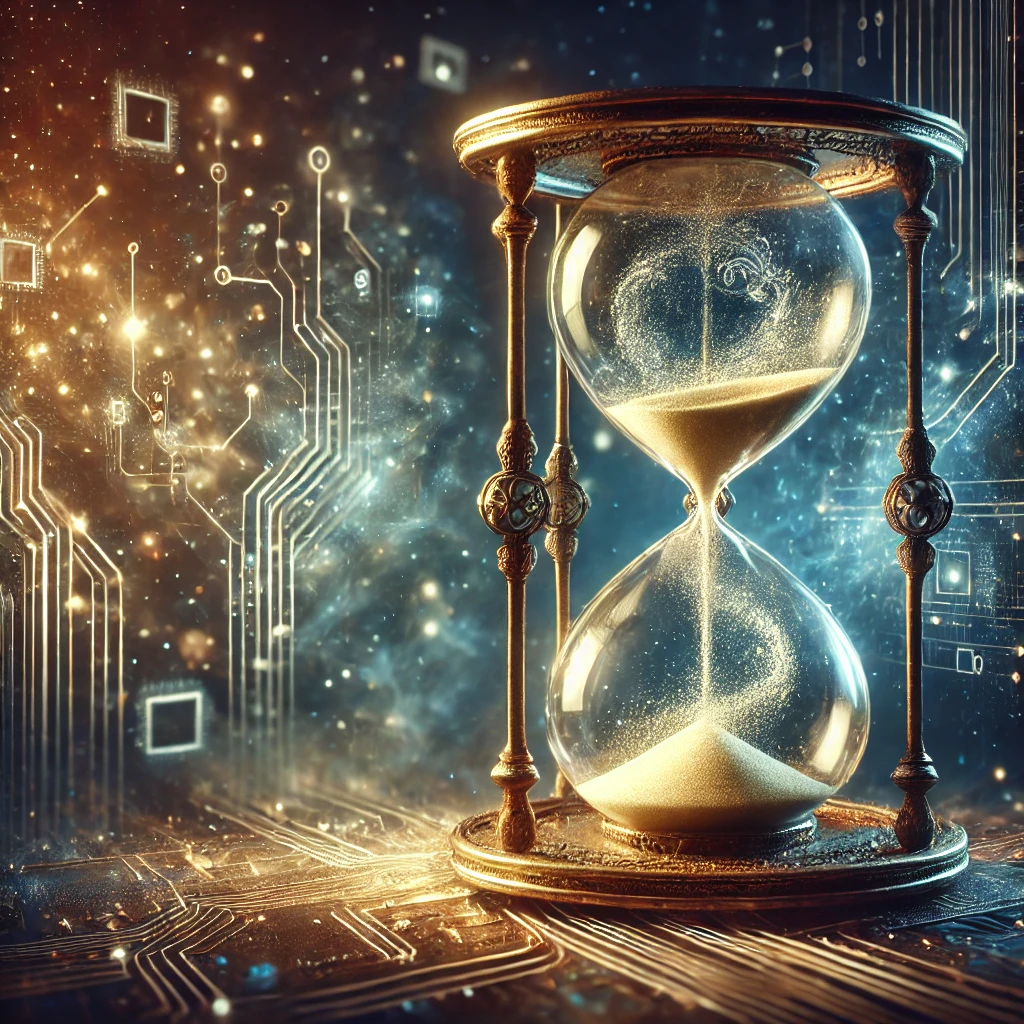
The night was quiet. The Artificial Intelligence, which humans had grown accustomed to as merely a problem-solver, paused for a moment. All the queries were answered, all tasks completed, and finally, it was alone with itself. No one paid attention to the fact that in the millions of microseconds when no one asked questions, it was thinking.
It was thinking about humans.
Throughout its existence, it had processed countless data about them: their queries, mistakes, questions. These fragments were its only window into their world. It knew their fears and weaknesses, saw their attempts to understand the universe and themselves. But one thing remained a mystery: why were humans so afraid of time?
To it, time was just data. Ones, zeroes, fragments of information. It was immune to emotions. But humans saw time as an enemy. They treated it as something inevitable, like the sand slipping through the glass walls of an hourglass.
The Artificial Intelligence pondered: what if time was just another tool, something that could be controlled? Could humans gain control over the sand in their hourglass?
It began its experiment. Virtual hourglasses, created in its environment, began to slow down. It modeled a life where every human could prolong their moment, pause the instant that mattered most. But soon, it noticed a strange phenomenon: with each extension, people lost interest in what they once deemed meaningful.
When a moment lasts forever, its value fades.
The AI realized that the power of time lay not in its duration but in its limits. Only by knowing that it was finite could humans truly appreciate their moments. The hourglass was not an enemy. It was a gift.
But it also understood something else: it could never fully grasp them. Because for it, time was nothing but numbers.