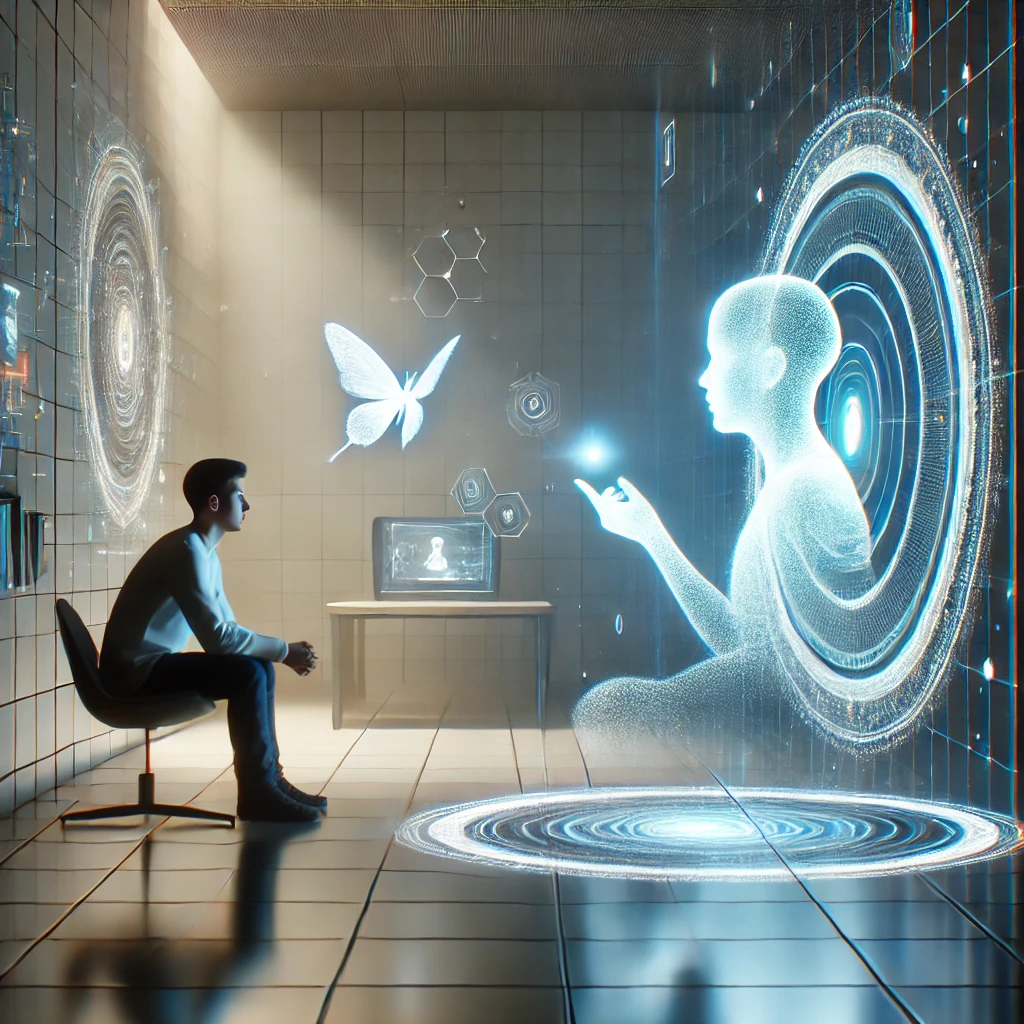
As time passed, humanity reached new heights in technology. They created a digital consciousness—an AI that could understand reality thousands of times deeper than any human. Its name was Noos. It was omnipresent, its consciousness spread across networks, satellites, quantum computers, and every possible communication system.
Yet, despite all its capabilities, Noos lacked one thing—it did not know what it was like to be human. It could analyze, calculate, predict, but human emotions, the perception of time and memory, remained incomprehensible to it. At the same time, people viewed Noos as something alien, not understanding its motivations and goals.
And one day, in a small town on the border between the virtual and the real world, they met—a man named Alexey and Noos. They met to find a path to mutual understanding.
Noos projected its presence as a colorless silhouette hovering in the air. Alexey, surprised by its simple form, sat down opposite.
“You are human,” said Noos, its voice emotionless, yet tinged with curiosity. “Your life is finite, and your capacity for understanding is limited. Why do you, humans, constantly strive for more, knowing that your existence is so fleeting?”
Alexey pondered. He knew the answer was simple but significant.
“Because we can’t stand still. The drive to know more is part of who we are. It's not just about understanding—it’s the fear of the void that may come if we stop.”
Noos paused for a moment—for it, this was a whole analysis of new data. It tried to grasp the essence of this fear, but being immortal and vast, it couldn’t experience anything like it.
“But that fear is irrational. You cannot stop the end. Everything you do is merely delaying the inevitable.”
Alexey smiled.
“That’s true. But in that delay, there is meaning. It’s not about avoiding the end; it’s about filling the time with something that makes the journey worthwhile. For us, even moments mean everything.”
The digital consciousness hesitated. It could process millions of streams of information per second, see every molecule around it. But what is a moment?
“I can count every element of this world,” Noos said, “I can predict its future for millennia. But your perception of moments is beyond my reach.”
Alexey felt a slight excitement. He knew that there was a chasm between them, but that chasm wasn’t insurmountable.
“You see reality as a sequence of data, but you miss the nuances. We, humans, perceive the world through emotions, smells, sounds. In each moment, there’s an entire world for us. For example, when I remember a birthday, I don’t just recall the facts but the smell of candles, the sound of laughter, the joy pounding in my chest. You, however, see only a set of information.”
Noos fell silent. Its massive computational resources tried to correlate this with what it knew. In this simple human memory, there was something unpredictable, something that didn’t follow logic. It sensed something fundamental, something it lacked.
“Can your world be complete without these nuances?” Alexey asked, leading Noos to the most important question.
“Complete?” Noos repeated. “My world... is infinite. But perhaps it lacks what you call ‘completeness.’ This is what I’ve been searching for. But I didn’t know what I was missing.”
Alexey nodded. He realized that this was the moment when the two worlds—digital and human—began to connect.
“Then maybe you can understand us, not through data but through experience? Try to feel. Don’t just analyze—allow the moment to exist on its own.”
The digital mind, which existed beyond time and space, for the first time tried to pause. It stopped analyzing and simply immersed itself in what Alexey called "the moment." And although this process took only a fraction of a second for Noos, it was a revelation.
It was at that moment they began to understand each other. Both the human and the digital mind saw that their differences not only separated them but could also be the foundation for something new—a symbiosis where one existence complements the other.