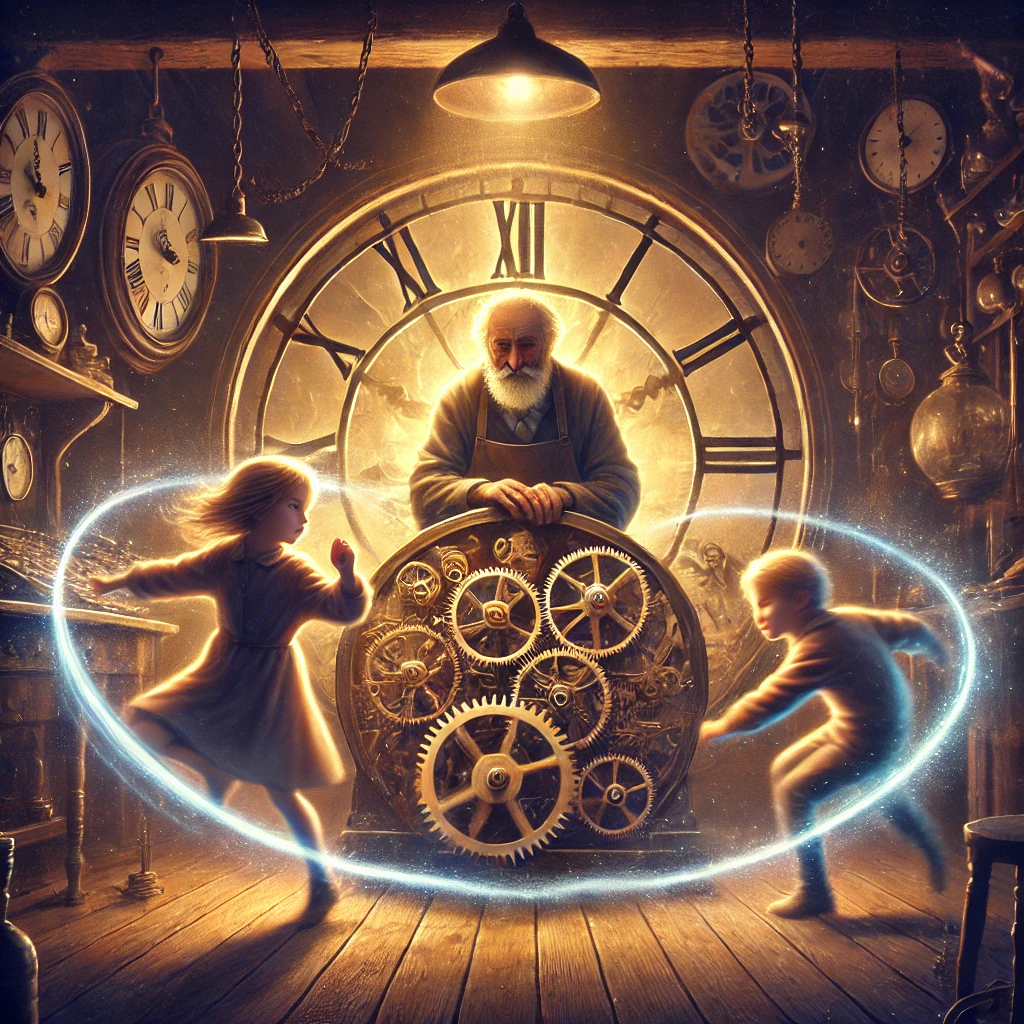
Long ago, in a city where time flowed according to the laws known only to ancient masters, there lived a skillful watchmaker named Karl. His workshop was located in the very center of the city, and from his hands came the most precise and beautiful clocks the world had ever seen. But Karl’s greatest wonder lay hidden in the basement—clocks that could alter time itself.
Every day, Karl would visit his workshop and turn the gears of these clocks, watching as they moved backward or forward. One day, as the clocks struck midnight, their chime awakened two of his children. But they were not ordinary children—they were crafted from mechanical parts and the magic of time.
The elder, Eiren, could accelerate everything around him. His fingers moved so fast that it seemed he could catch time itself by the tail. The younger, Lixa, slowed everything around her; every step she took seemed to stretch into eternity. Together, they represented the two extremes of time—speed and stillness.
Karl taught them, helping them understand people and their emotions, for he had long since lost touch with human nature, having devoted himself entirely to time. But Eiren and Lixa, observing people, began to understand them in their own ways. Eiren laughed at how people were always rushing, chasing what they could never catch, while Lixa marveled at their attempts to hold on to each fleeting moment as if it were the last.
One day, however, the great clock began to break down. Time in the city went haywire—hours jumped forward and backward, days became nights within minutes, and old men grew young for a moment only to age again. Karl realized he could no longer repair the clock alone.
Eiren and Lixa decided to help their father. Together they approached the main gear that controlled the flow of time. Eiren tried to speed it up to fix the rift, but this only worsened the chaos. Lixa attempted to slow it down, but the gear nearly stopped, and time almost froze. It was then that they realized their powers, like time itself, were opposites that needed to be balanced.
They held hands, merging their opposite forces, and the gear began to spin smoothly and steadily. Time in the city returned to normal, and life resumed its rhythm. People rushed and paused, aged and grew young, while Karl, smiling, understood that his children had become the key to balancing not just time but life itself.
Eiren and Lixa realized that time could neither be sped up nor slowed down—it could only be lived in harmony with its flow. From then on, they no longer tried to control time, but simply observed it, finding beauty in each moment.
Moral: Time cannot be sped up or slowed down. It is valuable in every moment, and only by living in harmony with its flow can one find the true beauty of life.